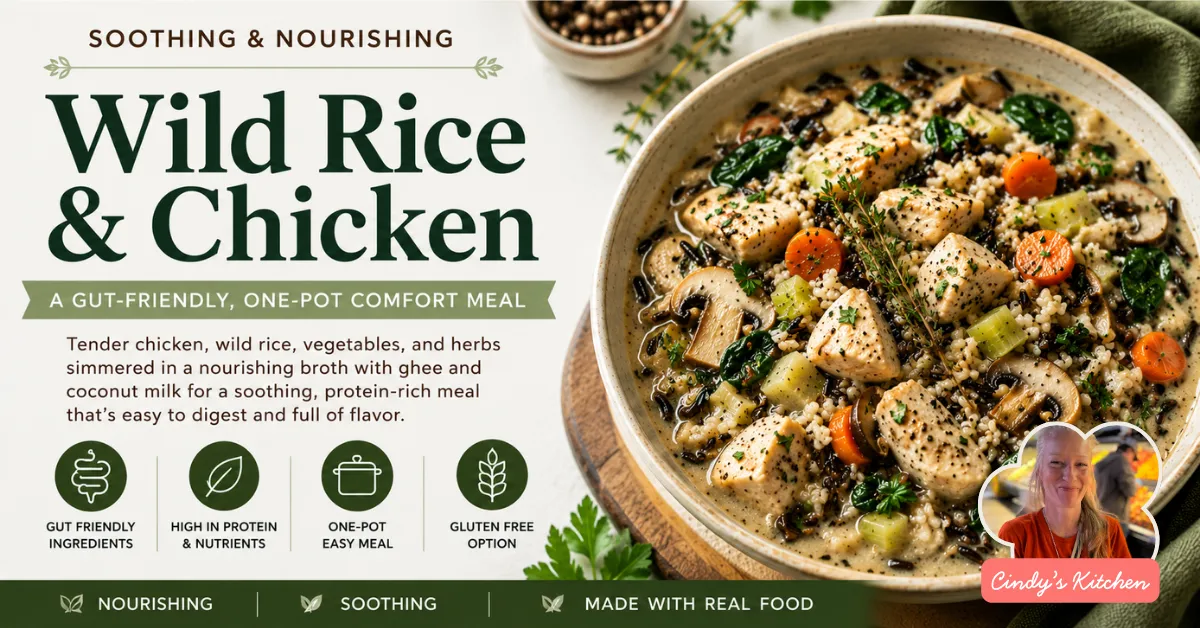
Soothing Wild Rice & Chicken: A Nutrient-Dense Comfort Meal for Gut Health
Recipes, Healthy Cooking, Gut Health
Soothing Wild Rice & Chicken: A Nutrient-Dense Comfort Meal for Gut Health
Make this healthy chicken and wild rice recipe as a simple one-pot meal with vegetables, bone broth, and easy options for sensitive stomachs, dairy-free, or gluten-free diets.
There is something especially comforting about a warm bowl of chicken and wild rice. It is hearty without being heavy, packed with whole-food ingredients, and easy to adapt when your digestive system needs a little extra care.
This version takes classic creamy chicken and wild rice and builds it around protein, nourishing fats, vegetables, herbs, and a flavorful broth. It can also be adjusted for dairy sensitivity, gluten avoidance, excessive fermentation, or simply to increase the nutrient density of an everyday meal.
The goal is not to label individual foods as universally “good” or “bad.” Gut tolerance is highly individual. Think of this recipe as a nourishing foundation you can modify based on what works for your body.
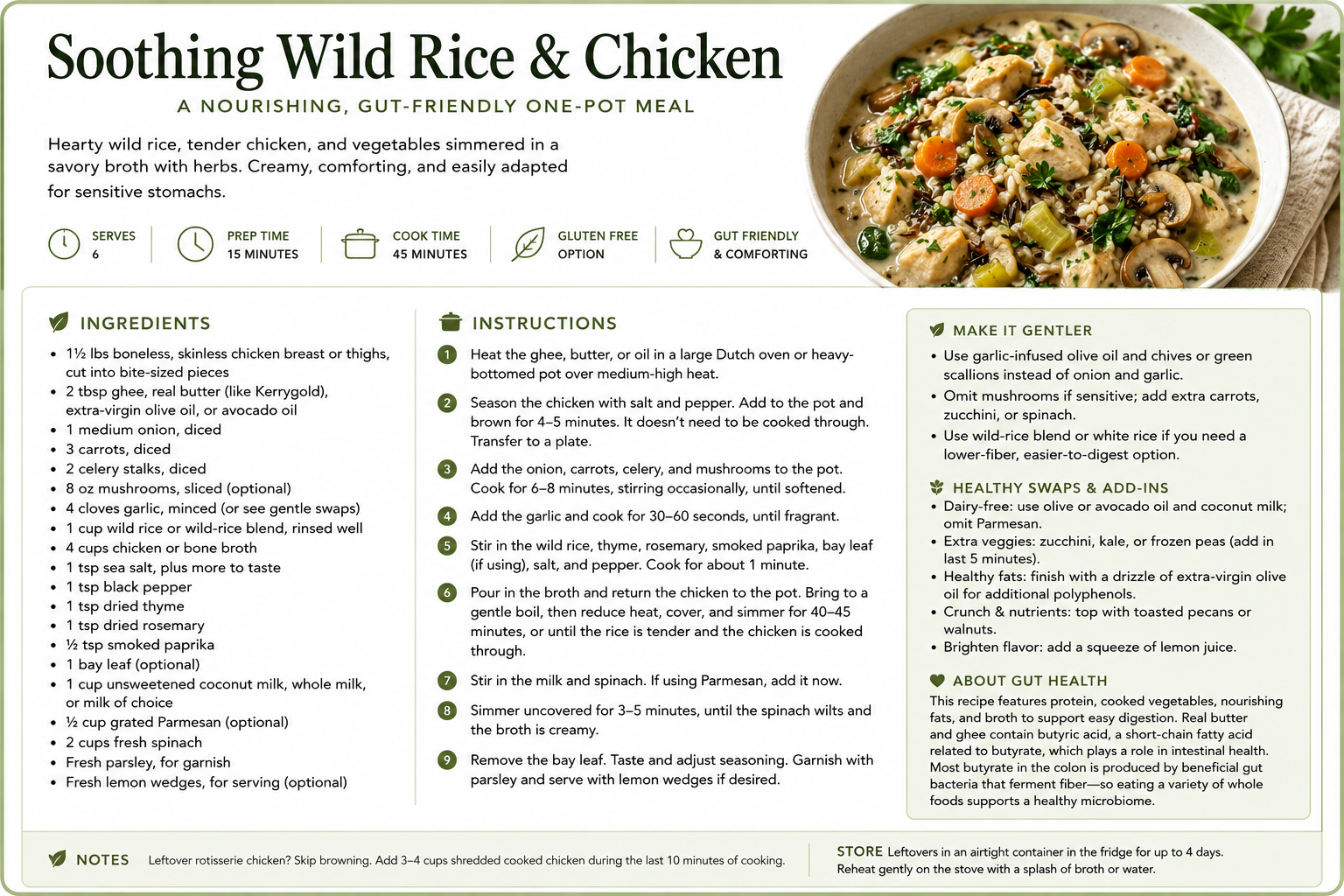
Download the Recipe Card
Want the quick version for your kitchen? Download Cindy's Soothing Wild Rice & Chicken recipe card so you can save it, print it, or keep it handy while you cook.
Why Wild Rice?
Despite its name, wild rice is not technically rice. It is the seed of an aquatic grass. Wild rice provides complex carbohydrates along with fiber, protein, minerals, and beneficial plant compounds. Its hearty texture makes a relatively small amount surprisingly satisfying. More fiber is not always better, particularly when the digestive system is irritated or excessive fermentation and bloating are already occurring. If pure wild rice feels too fibrous, use a wild-rice blend or substitute well-cooked white rice temporarily. Food should nourish you without making you miserable.
Soothing Wild Rice & Chicken (Serves approximately 6)
Ingredients
1½ pounds boneless skinless chicken breast, cut into bite-sized pieces
2 tablespoons ghee, real butter, extra-virgin olive oil, or avocado oil
1 medium onion, diced
3 carrots, diced
2 celery stalks, diced
8 ounces mushrooms, sliced
4 cloves garlic, minced
1 cup wild rice or wild-rice blend, rinsed well
4 cups chicken broth or bone broth
1 teaspoon sea salt, plus more to taste
1 teaspoon black pepper
1 teaspoon dried thyme
1 teaspoon dried rosemary
½ teaspoon smoked paprika
1 bay leaf, optional
1 cup unsweetened coconut milk, whole milk, or milk of choice
½ cup freshly grated Parmesan, optional
2 cups fresh spinach
Fresh parsley
Fresh lemon, optional
Directions
Heat the ghee, butter, or oil in a large Dutch oven or heavy-bottomed pot over medium-high heat. Lightly season the chicken with salt and pepper. Add it to the pot and brown for about 4–5 minutes. It does not need to be fully cooked at this stage. Transfer the chicken to a plate.
Add the onion, carrots, celery, and mushrooms to the same pot. Cook for 6–8 minutes, stirring occasionally, until the vegetables begin to soften.
Add the garlic and cook for another 30–60 seconds, just until fragrant.
Stir in the rinsed wild rice, thyme, rosemary, smoked paprika, bay leaf, salt, and pepper. Cook everything together for about one minute.
Pour in the broth and return the chicken to the pot. Bring to a gentle boil, then reduce the heat, cover, and simmer for about 40–45 minutes. Cooking time varies depending on pure wild rice versus wild-rice blends, so also check the package directions. The rice should be completely tender.
When the rice is cooked, stir in the milk and spinach. If you tolerate dairy and want an even creamier dish, add the Parmesan. Simmer uncovered for another 3–5 minutes, until the spinach wilts and the broth becomes creamy. Remove the bay leaf.
Taste and adjust the seasoning. Finish with fresh parsley and, if you like, a squeeze of lemon.
💡 Pro Tip: This chicken wild rice one-pot meal is excellent for meal prep. Store it in the fridge and reheat gently, adding a splash of broth or milk if it thickens.
Estimated Nutrition for Soothing Wild Rice & Chicken
These estimated nutrition values are based on the recipe card version prepared with 1½ pounds skinless chicken breast, 2 tablespoons ghee, 1 cup dry wild rice, 4 cups chicken bone broth, vegetables, spinach, and 1 cup unsweetened carton coconut milk, divided into 6 servings. Optional Parmesan is not included in the base calculation. Actual nutrition will vary with your broth, milk, cooking fat, and chicken cut.
Nutrition per serving (1/6 of recipe)
345 calories | 38g protein | 28g carbs | 9g fat | 4g fiber
Nutrient Highlights
Potassium: 842 mg
Magnesium: 108 mg
Calcium: 152 mg
Iron: 2.5 mg
Zinc: 3 mg
Selenium: 38 mcg
Vitamin A: 39% DV
Vitamin K: 52% DV
Vitamin B6: 58% DV
Niacin (B3): 121% DV
Vitamin B12: 24% DV
Why we like it: This is a protein-rich, nutrient-dense meal providing nearly 38 grams of protein per serving, along with meaningful amounts of magnesium, potassium, selenium, zinc, and B vitamins.
Nutrition is estimated and will vary depending on the chicken, broth, milk, cooking fat, and optional Parmesan used. Sodium can vary considerably depending on the broth; choosing low-sodium or unsalted broth gives you more control.
Don't Be Afraid of Real Butter
Butter is sometimes placed on the “inflammatory foods” list, but nutrition is more nuanced. Real butter is primarily a mix of saturated and monounsaturated fats and naturally contains butyric acid, a short-chain fatty acid related to butyrate. Butyrate is especially interesting when we talk about gut health. Cells lining the colon use butyrate as an important energy source, and it participates in intestinal-barrier and immune functions.
That does not mean that eating more butter automatically leads to more butyrate production. Much of the butyrate available in the colon is produced by beneficial gut microbes when they ferment certain types of dietary fiber and resistant starch. But it does mean we do not have to automatically remove real butter from a recipe built around whole foods. Choose minimally processed butter made mostly from cream and salt.
📌 Key Takeaway: If you tolerate dairy, a small amount of quality butter can absolutely be part of gut-friendly comfort food without demonizing fat.
Ghee Is Another Great Choice
Ghee may be my favorite cooking fat for this particular recipe. It provides the richness of butter and naturally contains butyric acid, but the clarification process removes most milk proteins. That means ghee contains very little lactose and casein compared with regular butter and may be better tolerated by some people with dairy sensitivities.
Ghee also has a higher smoke point than regular butter, which makes it especially useful for browning the chicken and sautéing the vegetables. Extra-virgin olive oil is another excellent choice, especially if you want more monounsaturated fats and naturally occurring polyphenols. The main principle is simple: choose minimally processed fats that work well for your body, instead of assuming that dietary fat itself is “inflammatory.”
💡 Pro Tip: If you are looking for a dairy-free chicken and wild rice option, use extra-virgin olive oil or avocado oil instead of butter or ghee.
Make It Gentler on a Sensitive Gut
A food can be very nutrient-dense and still trigger digestive symptoms for a particular person. If you experience significant bloating, gas, or excessive fermentation, temporarily simplifying the recipe can make a big difference. Onion and garlic are common “culprits” because they contain highly fermentable carbohydrates.
Instead of using whole onion and garlic, sauté the vegetables in garlic-infused olive oil and use chopped chives or the green tops of scallions to add flavor. Mushrooms can also be problematic for some sensitive digestive systems. Simply leave them out and add more carrots, zucchini, or spinach. And you do not need to add beans or legumes just because they are high in fiber.
The goal is not to eliminate these foods forever. The point is to match what you are eating to your digestive system’s current capacity.
📌 Key Takeaway: Even a very healthy chicken and wild rice meal is worth simplifying sometimes if your gut is sending signals that it needs a break.
Reduce Common Allergens Without Losing the Comfort
For someone who needs to avoid dairy completely, use extra-virgin olive oil or avocado oil instead of butter or ghee, choose unsweetened coconut milk, and skip the Parmesan. If lactose is the primary issue rather than a true allergy to milk proteins, ghee may still be an option because most of the milk solids have been removed.
The base recipe can also be naturally gluten-free. Simply make sure your broth and any pre-mixed seasonings are gluten-free if cross-contact is a concern. You do not need flour to thicken this dish. The starch released as the rice cooks naturally gives the broth body.
💡 Pro Tip: This gluten-free chicken and wild rice base is a great starting point when you are cooking for several people with different dietary needs.
Rethink the Chicken
Chicken is convenient, affordable, and an excellent source of protein, but it does not have to be the only protein in your rotation. If you are intentionally trying to reduce omega-6 fatty acid intake, choose skinless chicken breast instead of fattier cuts and avoid frying it in omega-6-rich vegetable oils.
You can also rotate this meal with turkey or other protein sources. Then, intentionally add omega-3-rich foods in other meals, especially fatty fish like salmon, sardines, and trout. The overall eating pattern matters more than having a single “perfect” meal.
Use Bone Broth for More Than Flavor
Replacing water with good-quality chicken broth or bone broth adds tremendous flavor without relying on a heavy sauce. Bone broth can also provide protein and amino acids, making it a useful addition to a nutrient-dense meal.
Look for broth with a relatively simple ingredient list and without unnecessary added sugars or fillers. For people who know they do not feel well with long-cooked or long-stored foods, freshly prepared or quickly frozen broth may be better tolerated.
📌 Key Takeaway: In a bone broth chicken recipe, the broth provides both flavor and extra nutrients, without the need for complicated sauces.
Layer in More Nutrition
One of the simplest ways to upgrade a meal is to add nutrients without making the ingredient list overwhelming. Toss in an extra handful or two of spinach at the end of cooking. Add zucchini along with the carrots. Finish each bowl with fresh parsley. Add a squeeze of lemon to brighten the flavor.
You can also drizzle the finished bowl with a bit of high-quality extra-virgin olive oil instead of adding more cream. And do not underestimate herbs. Rosemary, thyme, parsley, and garlic are not just there to make healthy food “tolerable.” Herbs and spices contain a huge variety of natural plant compounds and are an easy way to increase dietary diversity.
💡 Pro Tip: For families, this dish is a simple healthy family dinner—just add a salad or cooked vegetables and dinner is done.
The Simplest Sensitive-Gut Version
When digestion is particularly uncomfortable, temporarily strip the recipe back to the basics: skinless chicken breast; wild-rice blend or well-cooked white rice; carrots, zucchini, spinach; ghee (if tolerated) or extra-virgin olive oil; garlic-infused olive oil instead of fresh garlic; simple chicken or bone broth; thyme, rosemary, and sea salt.
You still have protein, carbohydrates, nourishing fats, cooked vegetables, herbs, and broth, without overloading the meal with highly fermentable ingredients. As digestion becomes more comfortable, you can gradually expand both foods and fibers according to your individual tolerance.
📌 Key Takeaway: This simplified version is still a complete gut health recipe—just gentler on the digestive system.
A Better Kind of Comfort Food
Supporting gut health does not have to mean living on plain chicken and steamed vegetables. Start with real ingredients. Make sure you are getting enough protein. Choose your fats thoughtfully. Cook vegetables until tender when your digestion needs extra support. Do not be afraid of good-quality butter or ghee if you tolerate them. Use fiber strategically instead of assuming that “more” is always “better.” And pay attention to how your own body responds.
A healthy gut ultimately benefits from a diverse diet, but there are also times when simplifying your food can be helpful. That is exactly what makes this wild rice and chicken such a good recipe to keep around. It can be rich and creamy for the whole family, or pared back into a simple, soothing meal when your digestive system needs a little less work. Either way, you end up with a warm bowl of tender chicken, vegetables, herbs, broth, and wild rice—and comfort food that actually brings something nourishing to the table.
“Comfort food can be both soothing and nourishing—especially when it is built from simple, whole-food ingredients that truly support your body.”
Disclaimer: Nutrition and digestive tolerance are individual. This information is provided for general wellness and educational purposes and is not intended to diagnose, treat, cure, or prevent disease or replace individualized medical or nutritional care.